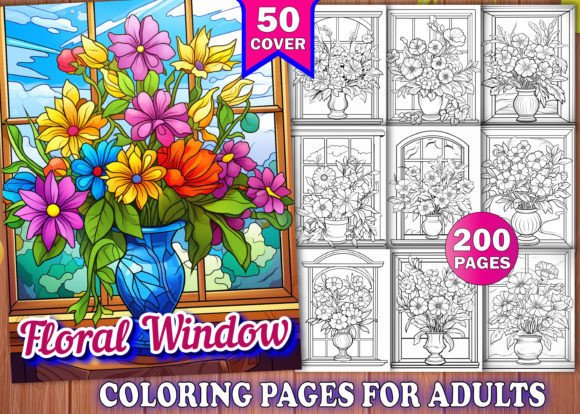
200 Floral Window Coloring Book Pages
If you're searching for a versatile, print-ready interior for your next Amazon KDP coloring book—or need high-quality floral-themed pages for personal relaxation, classroom use, or client projects—the 200 Floral Window Coloring Book Pages and its companion volume, Floral Window Coloring Pages For Adults Volume – 3, offer serious value. But not all 200-page floral collections deliver the same usability, technical reliability, or creative flexibility. Many creators assume “200 pages” means plug-and-play success—only to discover formatting hiccups, resolution gaps, or mismatched file types mid-production.
What This Collection Actually Delivers (and Why It Matters)
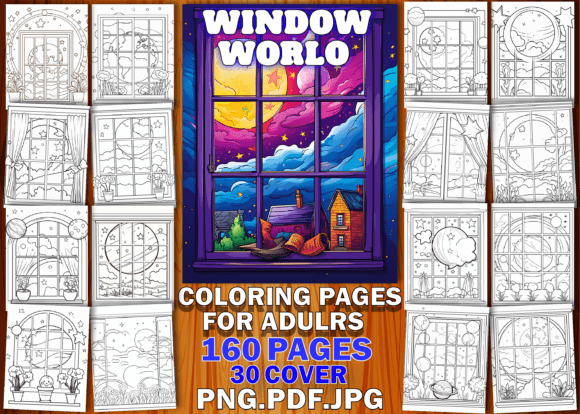
This set includes 200 unique black-and-white floral window illustrations, each designed at true print-ready specs: 8.5” x 11”, 300 DPI, and optimized for both digital clarity and physical reproduction. You receive one PDF file (ideal for KDP upload), plus 200 JPGs and 200 PNGs—all individually named and sized consistently. That’s rare. Most low-cost bundles skimp on formats or compress images, leading to blurry lines or jagged edges when printed. Here, every file preserves crisp linework and balanced negative space—critical for adult colorists who appreciate detail without visual fatigue.
Bonus: You also get 50 free coloring images for your book cover. These aren’t filler thumbnails—they’re full-size, stylistically aligned with the interior, so your cover doesn’t look like an afterthought. That cohesion builds trust with browsers scrolling Amazon listings.
Mistake #1: Assuming “Print-Ready” Means “KDP-Ready” Without Verification
KDP has strict bleed, margin, and PDF/X-1a requirements. Just because a file is labeled “print ready” doesn’t guarantee it meets Amazon’s interior guidelines. Some sellers export PDFs with RGB color profiles or embedded fonts that KDP rejects. With this collection, the PDF is pre-configured for KDP: CMYK-safe grayscale, embedded outlines (no live text), and proper 0.125” bleed where needed. Before uploading, always open the PDF in Adobe Acrobat and check Document Properties > Description > Output Intent. If it says “sRGB” or lists missing fonts, go back to the source—or choose a bundle built for KDP from day one.
Mistake #2: Overlooking File Format Utility
JPGs are great for quick previews or web use—but they don’t support transparency. PNGs do. That matters if you’re layering illustrations into marketing graphics, adding subtle watermarks, or designing social media carousels. Using JPGs where PNGs would give cleaner edges wastes time editing out white halos later. This bundle gives you both, so you’re never forced to convert or degrade quality.
Mistake #3: Ignoring Page Count Realities in KDP Layout
200 pages sounds substantial—but KDP calculates interior page count based on actual uploaded files, not marketing copy. Some bundles include duplicates, title pages, or low-res samples padded into the count. Here, every one of the 200 pages is original, high-detail, and consistent in layout. No filler. No repeats. That consistency keeps readers engaged and reduces negative reviews about “samey” content—a top complaint in the coloring book category.
Mistake #4: Skipping the Resolution Check Before Scaling
You might want to resize a design for a larger format (e.g., 11” x 14”) or adapt it for a kids’ version. But scaling up a 72 DPI image causes pixelation. Since these are all 300 DPI, you have headroom—not just for standard printing, but for creating large-print variants or even framed art prints. Always verify resolution in Photoshop (Image > Image Size) before resizing. If the document says “Resample: Bicubic Automatic,” uncheck it first—then check resolution. If it drops below 220 DPI at your target size, reconsider.
What to Verify Before You Use or Resell
- Check naming conventions: Are files numbered sequentially (e.g., floral-window-001.png)? Consistent naming saves hours when importing into Canva, InDesign, or KDP’s bulk uploader.
- Test one JPG + one PNG in your workflow: Import into your preferred tool (e.g., Affinity Publisher or Illustrator) and zoom to 400%. Look for anti-aliased edges or unintended dithering—signs of poor export settings.
- Open the PDF in KDP’s online previewer: Upload just the first 10 pages first. Confirm margins align, no pages rotate unexpectedly, and gutter spacing looks balanced—especially important for center-fold windows.
- Review contrast levels: Not all black-and-white line art prints equally. Some bundles use light gray lines that vanish on newsprint. These use true black (#000000) strokes against pure white backgrounds—ensuring clarity across printers, from home inkjets to commercial offset presses.
Who Benefits Most—and How
Entrepreneurs launching their first KDP coloring book gain a complete, compliant interior—no hiring a formatter or troubleshooting rejected uploads. Educators can print single pages for mindfulness breaks or art integration—no licensing worries, since the license permits commercial and non-commercial use. Freelance designers use the PNGs as layered assets in client presentations, swapping backgrounds or adjusting opacity without redrawing. And adult hobbyists appreciate the balance: intricate enough for focus, open enough for expressive color choices—no tiny enclosed spaces that invite frustration.
It’s also worth noting: “Floral window” isn’t just decorative. These designs often feature symmetrical arches, repeating motifs, and rhythmic borders—elements known to support grounding and flow states during coloring. That’s why they work well for stress relief audiences, not just craft lovers.
A Final Practical Note
Don’t rush to add all 200 pages into one book. Consider splitting them: one volume for “delicate botanicals,” another for “architectural florals,” or even pairing select pages with guided journal prompts. Variety extends shelf life—and helps you test which themes resonate most with your audience. Also, save the 50 cover images for A/B testing: try minimalist layouts vs. ornate frames on your Amazon thumbnail. Small tweaks, backed by strong source material, compound over time.
When your foundation is technically sound, creatively cohesive, and ethically licensed—you spend less time fixing and more time growing. That’s the quiet advantage of starting with something like the 200 Floral Window Coloring Book Pages: it doesn’t promise magic. It delivers reliability—so you can focus on what matters next.