Airplane Backgrounds for Covers
If you’ve ever scrolled through Amazon KDP, browsed a craft store’s coloring book section, or helped a child pick out a new activity book, you know how much first impressions matter. A cover isn’t just decoration—it’s the first signal of tone, audience, and intention. That’s where Airplane Backgrounds for Covers becomes more than a design asset: it’s a practical tool for creators who need to communicate quickly, connect emotionally, and stand out visually—without spending hours in Photoshop.
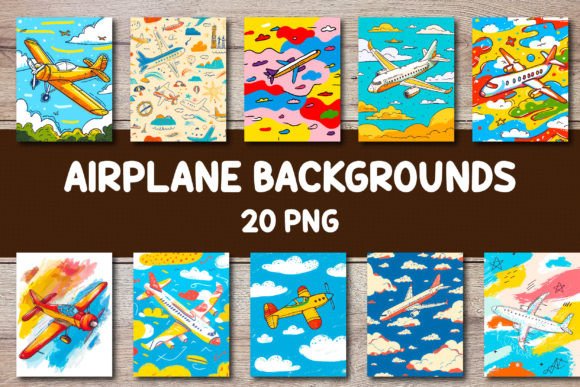
At its core, Airplane Backgrounds for Covers is a curated collection of 20 high-resolution PNG files—each built around an aerial or aviation-inspired scene—designed specifically to serve as backdrops for coloring book covers. These aren’t generic sky photos or clipart-style planes. They’re thoughtfully composed: soft gradients over cloudscapes, vintage cockpit silhouettes against golden-hour horizons, stylized flight paths winding across minimalist maps, or abstract geometric fuselages layered with delicate line art. Every background balances negative space and detail so text overlays stay legible, and coloring elements remain inviting—not overwhelming.
When and Where These Backgrounds Actually Get Used
Real-world use starts long before “publishing.” Think about Maya, a freelance graphic designer in Portland who builds KDP coloring books for niche audiences—like “Stress Relief for Nurses” or “Adventure Coloring for Homeschoolers.” She uses Airplane Backgrounds for Covers not because she loves aviation, but because they give her a consistent visual language across themed series. A single airplane background—say, a soft-focus view from above a coastal airport—can anchor three different books: one titled Soar Through Anxiety, another Flight School Fun for Kids, and a third Aviation History Coloring Journal. Same background. Three distinct messages. Zero redesign time.
Then there’s James, a middle school art teacher in Ohio. He doesn’t sell books—he prints covers for classroom projects. Last month, his students designed their own “Dream Destination” coloring pages. Instead of scrambling for royalty-free images or risking copyright flags on Google Images, he dropped one of the airplane backgrounds into Canva, added student-drawn landmarks on top, and printed clean 8.5" x 11" covers in under ten minutes. No licensing stress. No pixelated blowups. Just crisp, classroom-ready results.
And consider Lena, who runs a small Etsy shop selling printable mindfulness kits. Her latest bundle—Grounded in Flight: A Calming Air Travel Coloring Set—targets anxious flyers and frequent travelers. She paired two airplane backgrounds (one serene cloudscape, one gentle airport terminal sketch) with original affirmations and breathing guides. The backgrounds didn’t just look nice—they reinforced the theme *before* the user opened the PDF. That subtle alignment builds trust and relevance fast.
Why This Bundle Fits Real Creative Workflows
It’s not about the number of files. It’s about how easily they integrate. Each background arrives as a 300 dpi PNG with transparent layers preserved—so if you’re designing in Procreate, Affinity Designer, or even PowerPoint, you can drop it in, resize without blur, and add your title, subtitle, or logo without clipping or distortion. No hidden watermarks. No forced attribution. No surprise licensing tiers.
That matters when you’re juggling deadlines. Imagine uploading a KDP interior file at 11 p.m., only to realize your cover looks washed out at thumbnail size. With these backgrounds, contrast and composition are already optimized for small-screen visibility—soft shadows, clear focal zones, balanced light/dark ratios. You’re not guessing whether it’ll read on mobile. You’re confident it will.
Also worth noting: these aren’t just for “airplane books.” The aesthetic translates. A stylized jet trail can become a metaphor for progress in a goal-tracking journal. A vintage propeller plane silhouette works beautifully behind “Retro Road Trip Coloring.” Even educators repurpose them as bulletin board headers or slide backgrounds for geography units—no aviation expertise required.
What to Consider Before You Use Them
First—know your audience’s expectations. If you’re making a coloring book for ages 6–9, avoid ultra-dense linework in the background. Kids need bold outlines and breathing room. The bundle includes lighter, bolder options specifically for that purpose. Likewise, adults seeking mindfulness often respond better to softer gradients and flowing lines than sharp angles or busy grids.
Second—check your text hierarchy. These backgrounds support typography, but they don’t replace thoughtful layout. Always test your cover with real font sizes: 24 pt for subtitles, 48+ pt for main titles. If your chosen background has strong horizontal lines (like runway markings), avoid center-aligned text that competes visually. Left-justify instead—or rotate your title slightly for contrast.
Third—think beyond print. If you plan to promote digitally—Instagram carousels, Pinterest pins, email headers—use the same background across formats. Consistency builds recognition. One airplane background used as your KDP cover, your Etsy banner, and your lead magnet PDF creates continuity no algorithm can ignore.
Who Benefits—and How It Shows Up in Their Day
- Self-publishers get faster time-to-market: swap backgrounds between series instead of commissioning new art for every launch.
- Educators save prep time while keeping materials visually cohesive across grade levels.
- Therapists and counselors use them to build custom handouts—like “Flying Past Worry” worksheets—that feel intentional, not generic.
- Bloggers and newsletter writers turn them into themed opt-in freebies (“Download Your Calm-Flight Coloring Page”) that convert because they feel personal, not templated.
- Hobbyists print one as a framed piece for a home office or nursery—no extra editing needed.
None of this works if the files are hard to use. That’s why the bundle skips complex layered PSDs and focuses on plug-and-play utility. You don’t need to “learn” how to use these. You open the folder, drag one in, type your title, and go. The creativity stays on *your* ideas—not wrestling with resolution settings or layer masks.
In short, Airplane Backgrounds for Covers meets creators where they are: pressed for time, protective of their brand voice, and committed to delivering something that feels both professional and human. It’s not about selling more airplanes. It’s about giving people the quiet confidence that their next project—whether it’s a bestseller, a classroom handout, or a gift for a nervous flier—starts with a cover that says exactly what they mean to say.