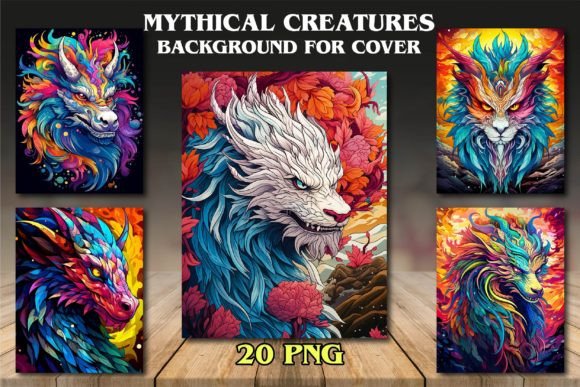
Mythical Creatures Backgrounds for Cover: A Practical Guide for Designers and Publishers
Mythical Creatures Backgrounds for Cover refers to a curated digital collection of 20 high-resolution, print-ready cover designs—each featuring iconic fantasy beings like dragons, griffins, phoenixes, unicorns, and krakens. Unlike generic fantasy assets or single-image downloads, this set is purpose-built for book covers, especially within Amazon KDP’s technical and aesthetic requirements. The designs are delivered as PNG files at 300 DPI, with transparent or cleanly masked backgrounds, enabling straightforward layering over titles and typography without additional editing.
What Sets This Collection Apart
Not all fantasy-themed cover assets serve the same function. Many free or low-cost resources prioritize visual flair over production readiness: they may lack sufficient resolution, include embedded watermarks, or use RGB color profiles unsuitable for offset printing. In contrast, Mythical Creatures Backgrounds for Cover emphasizes functional design integrity. Each image is pre-optimized for KDP’s cover upload specifications—including bleed-safe dimensions (typically 6" × 9" or similar standard trim sizes) and CMYK-friendly rendering—reducing the risk of pixelation, color shifts, or cropping errors during publishing.
The emphasis on “mythical creatures” also distinguishes it from broader categories like general fantasy backgrounds or nature-inspired motifs. Rather than abstract misty forests or celestial skies, these backgrounds center narrative-driven figures—often posed with intentionality, scale, and compositional balance that naturally frames text space. That intentional negative space is critical: it allows designers to add titles, author names, and subtitles without obscuring key details or forcing awkward overlays.
How It Compares to Other Design Approaches
Designers evaluating options typically consider three main paths: using pre-made background packs (like Mythical Creatures Backgrounds for Cover), commissioning custom illustrations, or generating assets via AI tools.
- Pre-made packs offer speed, consistency, and cost predictability. Mythical Creatures Backgrounds for Cover fits here—but stands out due to its narrow thematic focus and production-grade output. Broader bundles (e.g., “10,000 Fantasy Elements”) often sacrifice cohesion; users may spend hours sifting through mismatched styles or irrelevant assets. This collection avoids that friction by delivering only cover-ready scenes, each visually distinct yet stylistically harmonized.
- Custom illustration provides full creative control and brand alignment but requires budget (typically $200–$800+ per cover), time (1–4 weeks), and clear art direction. For indie authors launching multiple titles—or testing market response before investing in bespoke art—Mythical Creatures Backgrounds for Cover offers a pragmatic middle ground: professional quality without the overhead.
- AI-generated assets are increasingly accessible, but require careful vetting. While the description notes these images are AI-generated, their final refinement appears manual—evident in consistent line weight, balanced contrast, and absence of common AI artifacts (e.g., fused limbs, inconsistent anatomy). That level of post-processing matters: raw AI outputs often need significant cleanup before meeting KDP’s content policies or reader expectations for polished fantasy aesthetics.
Real-World Use Cases and Fit
This collection works best when your project aligns with specific practical and creative constraints:
- You’re publishing coloring books—especially for adults or older children—and need covers that signal theme and complexity without revealing interior line art. The dragon- or phoenix-themed backgrounds suggest depth and detail while preserving the interior’s meditative value.
- You’re developing a series (e.g., a fantasy romance trilogy or myth-based educational workbook) and want visual continuity across titles. With 20 coordinated designs, you can assign unique creatures to each volume while maintaining shared tonal language—more cohesive than sourcing disparate royalty-free images.
- You’re time-constrained: preparing a KDP launch alongside writing, formatting, and marketing. Having 20 print-ready options cuts down cover design time from days to hours—particularly if you pair them with compatible title fonts and layout templates.
It’s less ideal when you need highly specific symbolism (e.g., a creature representing Norse cosmology rather than generalized Western fantasy tropes) or require editable vector layers (these are raster PNGs, not SVG or layered PSD files). Similarly, if your audience expects photorealistic or painterly styles—rather than the clean, illustrative line work typical of adult coloring covers—this set may feel stylistically narrow.
Practical Considerations Beyond Aesthetics
Resolution and format matter more than they might appear. At 300 DPI, these backgrounds support both digital previews and physical print without degradation—a key differentiator from web-optimized (72 DPI) alternatives. PNG delivery ensures transparency where needed (e.g., placing a dragon silhouette over a gradient), though some designs use solid-color backdrops optimized for quick KDP uploads.
The included tags—like KDP Coloring Cover, Adult Coloring Background, and Mindful Coloring—reflect actual search behavior on Amazon and design marketplaces. That alignment helps creators understand how buyers discover similar products, informing not just cover selection but also backend keyword strategy and category placement.
That said, “high quality” doesn’t automatically mean “universally appropriate.” Some designs feature denser linework or busier compositions that may not translate well to smaller formats (e.g., paperback spines or thumbnail views). Previewing thumbnails at 150% zoom—simulating how a cover appears on mobile—is a useful check before finalizing.
When to Look Elsewhere
Mythical Creatures Backgrounds for Cover excels in efficiency and thematic clarity—but isn’t a universal solution. Consider alternatives if:
- You need full commercial rights for merchandise (e.g., t-shirts, mugs). Most pre-made cover packs restrict usage to book covers and related promotional materials—not derivative physical products.
- Your project targets niche subgenres requiring precise iconography—such as Slavic folklore (Zmey, Leshy) or Mesoamerican mythology (Quetzalcoatl, Camazotz). This collection draws primarily from widely recognized European and Near Eastern archetypes.
- You’re building interactive or animated digital products (e.g., an app-based coloring experience). PNGs lack animation capability or responsive scaling—SVG or Lottie files would be more suitable.
- Accessibility is a core requirement. While the designs are visually rich, they don’t include alt-text descriptions, semantic structure, or contrast-optimized variants for screen readers—something custom development could address.
Making an Informed Choice
Ultimately, choosing Mythical Creatures Backgrounds for Cover comes down to matching intent with execution. It’s a tool—not a replacement for thoughtful design decisions. Its value lies in reducing repetitive labor, offering reliable output, and supporting consistency across projects where fantasy resonance matters.
Before purchasing, review sample thumbnails for legibility at small sizes, verify compatibility with your layout software (e.g., Canva, Affinity Publisher, or Adobe InDesign), and cross-check KDP’s latest cover guidelines—especially around safe zones and bleed margins. If you’re new to cover design, pairing this pack with a simple grid-based template can yield strong results without advanced skills.
For experienced designers, it serves as a reliable starting point—freeing up time to focus on typography, hierarchy, and emotional tone rather than creature anatomy or shadow rendering. And for authors balancing creative and operational demands, it represents a measured investment: more intentional than stock photo browsing, less open-ended than full custom illustration.
Like any resource, its usefulness depends on context—not just what it is, but how, when, and why you apply it.