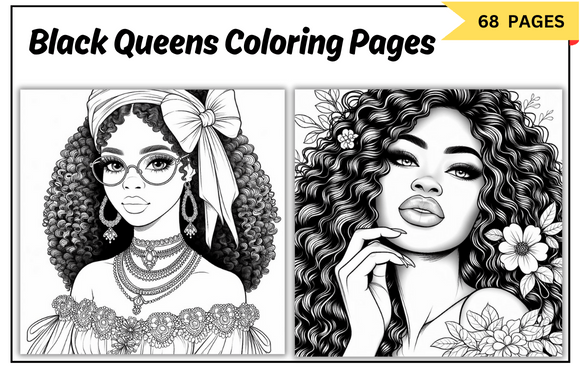
Black Queens Coloring Pages: A Thoughtful Choice for Meaningful Creative Expression
Black Queens Coloring Pages is a curated collection of adult coloring illustrations centered on the beauty, strength, and cultural richness of Black women and girls. Unlike generic coloring books that feature stylized or anonymized figures, this set intentionally highlights diverse facial features, natural hairstyles—such as Bantu knots, afros, box braids, and headwraps—authentic skin tones, and culturally resonant details like Adinkra symbols, kente patterns, and Afrocentric botanical motifs. Each design is hand-drawn with clean linework, balanced negative space, and intentional composition—optimized for relaxation, focus, and personal reflection.
What Sets Black Queens Coloring Pages Apart
The distinction lies not only in subject matter but in intentionality. Many adult coloring books prioritize ornamental complexity over representation; others include token figures without depth or consistency. Black Queens Coloring Pages avoids both pitfalls by centering Black womanhood across age, body type, expression, and context—from quiet moments of introspection to confident, regal postures. The illustrations are neither caricatured nor overly idealized; they reflect lived diversity with dignity and nuance.
This isn’t just “coloring pages with Black characters.” It’s a cohesive visual narrative designed for adults who seek affirmation, cultural resonance, or therapeutic grounding through art-making. The line weight is consistent (0.4–0.6 pt), suitable for fine-tip markers, gel pens, or colored pencils without bleeding—especially important for print-ready KDP interiors. All pages are formatted at 8.5 × 11 inches, bleed-free, and optimized for standard home printers and commercial KDP uploads.
How It Compares With Broader Adult Coloring Categories
When evaluating options, it helps to consider where Black Queens Coloring Pages fits within larger categories:
- General flower or mandala coloring books offer stress relief through repetition and symmetry—but lack narrative or identity-based resonance. They’re excellent for mindfulness practice, yet may feel emotionally neutral or even disconnected for users seeking affirmation.
- Birds and floral-themed books emphasize nature aesthetics and often feature intricate botanical layering. While visually rich, they rarely support identity exploration or intergenerational storytelling—key values for many who choose Black-centered creative resources.
- “Strong woman” or empowerment-themed books sometimes use abstract or symbolic figures (e.g., silhouettes, goddess archetypes). These can be inspiring but may lack specificity. Black Queens Coloring Pages grounds empowerment in recognizable humanity—making strength visible, relatable, and culturally situated.
- African or African American family-themed collections exist, but few maintain consistent artistic quality across all pages or prioritize adult-level detail. Some lean heavily into educational illustration (e.g., historical scenes) rather than open-ended creative engagement. Black Queens Coloring Pages strikes a balance: expressive enough for personal interpretation, detailed enough to sustain interest, and respectful enough to avoid appropriation or flattening.
Practical Considerations for Use and Adaptation
For creators using these pages in a KDP interior, the files are structured for immediate integration: no cropping needed, CMYK-safe grayscale line art, and clearly labeled layers (where applicable in editable versions). Each page stands alone—no cross-referencing or supplemental text required—making it adaptable for standalone books, themed volumes (e.g., “Black Queens & Botanicals”), or mixed-media projects.
That said, Black Queens Coloring Pages does not include guided journaling prompts, affirmations, or background essays—unlike some hybrid wellness-coloring titles. If your goal is integrative self-reflection with written reflection, you’d need to pair it with a separate journal or add those elements yourself. Similarly, while the illustrations honor African and African diasporic traditions, they do not serve as ethnographic references or lesson plans. They’re artistic interpretations—not textbooks.
Who Benefits Most—and When Other Options May Fit Better
This resource serves adults who value representation as part of their creative ritual—not as an afterthought, but as a core condition. Therapists, educators, and community facilitators report strong engagement when using these pages in group settings focused on identity, healing, or intergenerational dialogue. Individuals navigating racial stress, reconnecting with cultural roots, or simply craving imagery that mirrors their reality often describe a tangible shift in mood and presence while coloring.
Conversely, if your priority is maximal technical challenge—think hyper-detailed cityscapes or anatomical precision—Black Queens Coloring Pages may feel intentionally restrained. Its strength is emotional clarity, not visual density. Likewise, if you're building a children’s activity book, the line work and themes are calibrated for mature sensibilities; younger audiences may need simplified adaptations.
Another consideration: accessibility. The pages rely on contrast and clear outlines, which supports many users with low vision—but they don’t include tactile elements, braille labels, or high-contrast color guidance for screen readers. For fully inclusive design, supplementary tools would be necessary.
Real-World Applications Beyond Solo Coloring
Users have adapted Black Queens Coloring Pages across contexts in practical, grounded ways:
- A counselor prints select pages for clients exploring self-image, then discusses symbolism and choice of color as part of narrative therapy.
- An educator compiles ten pages into a classroom zine celebrating Black History Month—students color, then write short reflections on what “queen energy” means to them.
- A small press bundles the interior with a minimalist cover and publishes it as a limited-run gift book for Juneteenth events—priced accessibly, with proceeds supporting local Black-led arts initiatives.
- A content creator uses individual pages as backdrops for Instagram reels about mindful creativity, pairing each with voiceover commentary on hair texture, joy as resistance, or intergenerational care.
These examples highlight flexibility without overpromising versatility. The pages work well when aligned with purpose—not as a universal tool, but as a precise one.
Making Your Decision With Clarity
Choosing Black Queens Coloring Pages makes sense if you’re looking for: consistent, respectful representation; KDP-ready formatting; adult-level artistic integrity; and thematic cohesion rooted in Black femininity and cultural pride. It’s especially valuable when representation isn’t decorative—but functional, affirming, and integrated into daily practice.
It may be less suited if you require: built-in educational scaffolding, child-friendly simplification, multi-language support, or integration with digital coloring apps (as the files are print-first, PDF-based). Also, while the aesthetic leans elegant and serene, it doesn’t emphasize bold, graphic, or street-art styles—so users drawn to urban or contemporary illustration may want to explore complementary sets.
Ultimately, Black Queens Coloring Pages invites engagement on its own terms: not as escapism, but as reclamation. It doesn’t ask users to imagine themselves into beauty—it reflects beauty already present, varied, and unapologetic. That quiet certainty is what many return to, page after page.