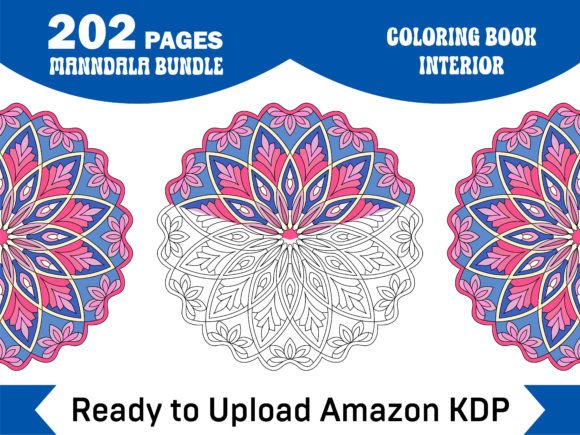
202 Pages Creative Haven Mandala for KDP
If you're building a scalable, low-overhead digital product business on Amazon KDP—especially in the evergreen colouring book niche—the 202 Pages Creative Haven Mandala for KDP isn’t just another interior file. It’s a production-ready asset engineered to reduce friction between idea and launch. Designed specifically for creators who value consistency, compliance, and speed, this 202-page interior bridges the gap between creative vision and platform-ready execution.
What It Is—and Where It Fits in Your Publishing Workflow
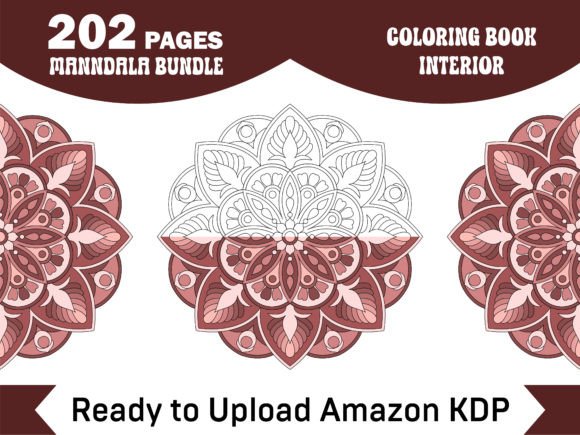
The 202 Pages Creative Haven Mandala for KDP is a complete, print-optimized PDF interior for a mandala colouring book—202 pages of fifty unique, hand-crafted mandala designs, repeated across variations to ensure visual richness without repetition fatigue. Each page is sized at 8.5″ × 11″ with no bleed, rendered at 300 DPI, and pre-tested on KDP’s previewer and live upload system. That means it skips the most common pre-launch delays: bleed adjustments, resolution warnings, margin rejections, or orientation mismatches.
In your publishing workflow, this file sits squarely in the *execution phase*—not ideation, not marketing, but the critical handoff from design to distribution. You don’t need illustration skills, layout software expertise, or hours of manual PDF assembly. Instead, you move directly from “I want to publish a mandala book” to “upload → validate → publish” in under 15 minutes.
How It Integrates With Your Existing Tools and Systems
This isn’t a siloed download—it’s built to interoperate. Alongside the final PDF, you receive a Canva template link containing all 202 pages in editable HD format. That means if you use Canva for branding (cover design, social assets, email banners), you can maintain consistent typography, spacing, and colour palettes across your entire product ecosystem. No need to export, re-import, or manually match fonts—you adjust once in Canva and apply globally.
For those using project management tools like Notion or ClickUp, the file works as a defined deliverable in your KDP product checklist: “Interior file received ✅”, “Cover matched to interior palette ✅”, “KDP preview validated ✅”. Its predictability makes it easy to batch-process multiple titles—say, launching seasonal variants (e.g., “Creative Haven Mandalas: Spring Edition”)—without redesigning core assets each time.
Preparation and Compatibility: What You Need (and Don’t Need)
You don’t need Adobe InDesign, Photoshop, or advanced PDF editing knowledge. The included PDF is KDP-compliant out of the box: CMYK-safe grayscale line art, embedded fonts (where applicable), correct page count, and proper spine calculation support (since it’s interior-only). You *do* need an active KDP account and a cover file—but that’s where the Canva template becomes especially useful. Use the same brand kit across both interior and cover to ensure visual cohesion before upload.
Compatibility extends beyond software. Because the designs are clean, high-contrast, and beginner-friendly, the book serves multiple audience segments simultaneously: adults seeking mindful decompression, educators sourcing classroom calm activities, therapists recommending grounding exercises, and parents looking for screen-free engagement for kids aged 8–14. That cross-segment utility means less A/B testing on targeting—you’re not choosing between “mandalas for teens” or “mandalas for seniors”; the interior naturally supports both.
Practical Implementation: From Upload to First Sale
Here’s how users actually deploy the 202 Pages Creative Haven Mandala for KDP in real-world scenarios:
- A freelance designer bundles it with a custom KDP cover and metadata package (title, subtitle, keywords, description), then delivers the full ready-to-publish bundle to clients—cutting their delivery timeline from 5 days to under 2.
- An educator uses select pages (pages 17–24, for example) as printable mindfulness handouts, then later publishes the full book under their school’s imprint—using the same interior for both internal use and public sale.
- A small publisher runs quarterly “theme drops”: they keep the interior constant but change the title, subtitle, and cover seasonally (“Creative Haven Mandalas: Focus Edition”, “Creative Haven Mandalas: Rest Edition”), maintaining backend efficiency while refreshing frontend appeal.
Each of these workflows relies on one foundational advantage: the interior doesn’t require rework. Once uploaded and approved, it stays approved—no version drift, no accidental edits, no forgotten bleed zones.
Quality Control and Long-Term Usability
Because the file has been tested on KDP’s live preview system—not just locally—the risk of post-upload surprises is minimal. That includes checking for gutter alignment (critical for centre-spread mandalas), edge clarity at trim size, and contrast fidelity on both screen and printed output. You’re not guessing whether line weight holds up at 300 DPI; you’re verifying it was built to hold up.
Long-term, the Canva template adds durability. If Amazon updates its KDP requirements (e.g., new margin standards or file naming conventions), you can regenerate the PDF in minutes—not days. Likewise, if you expand into Etsy or Gumroad, the same Canva file exports cleanly to PNG, PDF, or even animated walkthroughs for social proof.
Organisation and Efficiency Gains
The 202-page count isn’t arbitrary. It aligns with KDP’s royalty structure: books over 100 pages qualify for expanded distribution by default, and 202 pages comfortably clears the 150-page threshold where readers perceive “substance” without triggering shipping surcharges (since it’s digital). Page organisation follows a gentle progression—starting with simpler symmetrical forms (ideal for beginners), moving into layered geometry (for intermediate users), and ending with intricate radial compositions (for advanced colourists). This intentional sequencing reduces negative reviews citing “too hard too fast” or “boring repetition”.
From an operational standpoint, having fifty unique base designs—each appearing multiple times with variation—means you avoid the monotony of identical repeats while preserving production simplicity. No need to source 202 distinct illustrations; you get depth through smart reuse, not sprawl.
Realistic Expectations and Strategic Use
This isn’t a magic bullet for virality—but it *is* a force multiplier for consistency. If your goal is to build a portfolio of five KDP colouring books in six months, the 202 Pages Creative Haven Mandala for KDP lets you focus energy where it matters most: positioning, pricing, keyword research, and customer engagement—not layout troubleshooting. It shifts your bottleneck from *production* to *strategy*.
Users who see the strongest ROI treat it as infrastructure—not content. They pair it with a repeatable cover workflow (Canva + brand kit), a standardised description template, and a lightweight launch checklist. Over time, that compound efficiency lets them test new niches (e.g., “Mandalas for Nurses”, “Mandalas for Coders”) without resetting their entire pipeline.
Whether you’re launching your first KDP book or your fiftieth, the 202 Pages Creative Haven Mandala for KDP removes guesswork from the interior—so you can invest your attention where it creates leverage: audience connection, iterative improvement, and sustainable output.