230 Cute Animals Coloring Pages for Kids: A Practical Guide for Educators, Parents, and Self-Publishers
For educators designing classroom activities, parents seeking screen-free engagement, or independent creators building digital assets for platforms like Amazon KDP, 230 Cute Animals Coloring Pages for Kids represents a focused, production-ready resource. Unlike broad-themed collections or hand-drawn originals requiring cleanup, this set delivers consistency, technical readiness, and intentional curation — all centered on universally appealing animal subjects rendered in clean black-and-white line art.
What Sets This Collection Apart?
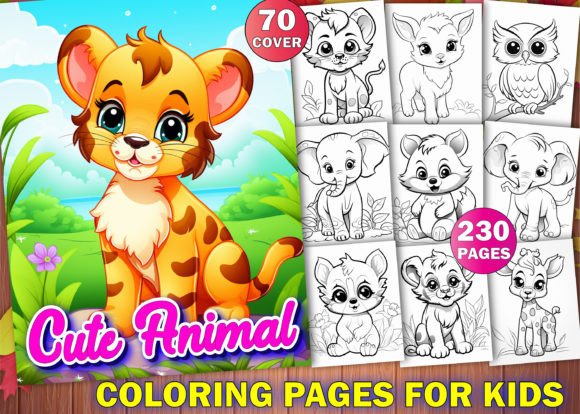
The core offering includes 230 distinct coloring pages, supplemented by Volume 2 — expanding the total usable content to 240 unique illustrations. Importantly, it’s not just quantity: every image is provided in three formats — PDF (print-ready), JPG, and PNG — all at 300 DPI resolution and standardized 8.5” x 11” dimensions. That means no resizing, no quality loss, and no guesswork when preparing files for printing or digital distribution.
Unlike many free or low-cost bundles that mix clipart-style graphics with inconsistent line weights or pixelated edges, these pages maintain uniform stroke clarity across species — from delicate mermaid-fish hybrids to bold tiger silhouettes and softly rounded unicorn manes. The inclusion of 70 additional images for book covers further signals thoughtful design for commercial use, especially for KDP creators who need cohesive branding across interior and exterior assets.
How It Compares to Other Animal-Themed Resources
Many animal coloring resources fall into one of two categories: high-volume generic sets (often 500+ pages but with repetitive poses or low-resolution exports) or artist-curated premium books (with strong aesthetic identity but limited format flexibility or licensing restrictions). 230 Cute Animals Coloring Pages for Kids occupies a pragmatic middle ground — optimized for usability rather than novelty or exclusivity.
For example, a teacher sourcing materials for kindergarten art time may find that some “cute animals” packs include overly complex scenes with fine details unsuitable for early learners. In contrast, this collection prioritizes clear outlines, generous negative space, and age-appropriate proportions — supporting motor skill development without frustration. Similarly, KDP publishers often struggle with mismatched cover-to-interior ratios or inconsistent file types; here, the bundled cover images match the interior’s DPI, scale, and stylistic tone — reducing prepress revisions.
Strengths in Real-World Use Cases
- Educational flexibility: Pages featuring deer, goats, elephants, and sheep support thematic units on habitats, life cycles, or farm vs. wild animals — and their simplicity allows for easy annotation or integration with vocabulary cards.
- Gender-inclusive appeal: While “cute” often skews toward pastel or stereotyped motifs, this set balances traditionally gendered subjects (e.g., unicorns, mermaids) with broadly engaging ones (octopuses, dinosaurs, tigers), avoiding over-reliance on any single trope.
- Technical reliability: All 240 PNGs and JPGs are transparent-background ready where appropriate (e.g., standalone animals for digital overlays), and the PDF is layered for easy page reordering — useful for customizing difficulty levels or seasonal themes.
Tradeoffs and Considerations
No single resource meets every need — and awareness of limitations helps avoid mismatched expectations. First, the collection focuses exclusively on cute interpretations: you won’t find realistic anatomical studies, scientific diagrams, or stylized minimalist animals. If your goal is comparative biology instruction or modern design projects, other specialized sources may be more suitable.
Second, while the 240 pages offer breadth across species — cats, dogs, horses, fish, lions, cows, deer, octopuses, and more — they don’t include habitat backgrounds, action poses, or cultural variations (e.g., regional breeds or mythological hybrids beyond unicorns/mermaids). For storytelling-based activities or culturally responsive curricula, supplementation may be necessary.
Third, although the files are print-ready, they do not include editable vector files (e.g., SVG or AI). Designers needing scalable assets for large-format posters or cut files will need to convert or source elsewhere — though the 300 DPI raster quality holds up well for standard book sizes and classroom handouts.
When This Is the Right Choice
This collection excels when your priority is speed, consistency, and functional clarity. It’s ideal for:
- KDP authors launching a new coloring book who want to validate demand with a professionally formatted interior before investing in original illustration;
- Early childhood educators building printable activity packets aligned with social-emotional learning goals (e.g., “calm-down” animal pages) or cross-curricular themes;
- Homeschooling caregivers seeking low-prep, high-engagement tools that support fine motor practice without screen time;
- Therapists or occupational specialists using structured drawing as part of sensory regulation strategies — where predictable line weight and uncluttered composition matter more than artistic flair.
When You Might Look Elsewhere
If your work requires:
- Customization beyond cropping or recoloring — such as editing individual layers or adjusting line thickness — vector-based alternatives would better serve long-term adaptability;
- Diverse representation beyond species — including animals from specific global ecosystems, endangered species with conservation notes, or inclusive human-animal interactions — then research-focused or NGO-published resources may add pedagogical depth;
- Multi-age differentiation — say, simplified versions for preschoolers alongside advanced versions for upper elementary — you’d likely need to pair this set with tiered extensions rather than relying on it alone.
Practical Integration Tips
Because the files are delivered in multiple formats, users can optimize based on workflow:
- For KDP interiors: Use the PDF file directly — its pagination and bleed settings are already configured for standard paperback dimensions.
- For classroom handouts: Export individual JPGs into a Google Slides deck, then use “Print as Handout” to generate multi-page PDFs with student instructions embedded.
- For digital learning platforms: Upload PNGs to Canva or Book Creator to layer text prompts (“Name three things this animal eats”) or audio recordings.
- For mixed-media projects: Print select pages on cardstock, then cut out animals for puppet-making, sorting games, or story sequencing — the bold outlines hold up well to glue and handling.
Final Thoughts for Decision-Makers
230 Cute Animals Coloring Pages for Kids isn’t designed to replace original illustration or deep educational frameworks — but it does fill a reliable, repeatable role in resource-constrained environments. Its value lies in what it removes: ambiguity about print quality, compatibility concerns, or stylistic inconsistency. When evaluating options, consider not just the number of pages, but how easily they integrate into your existing systems — whether that’s a lesson plan template, a KDP upload queue, or a weekly homeschool rhythm. In those contexts, this collection offers tangible efficiency without sacrificing visual warmth or developmental appropriateness.