54 Pages Alphabet Coloring Book for Kids: A Strategic Asset for Creators and Educators
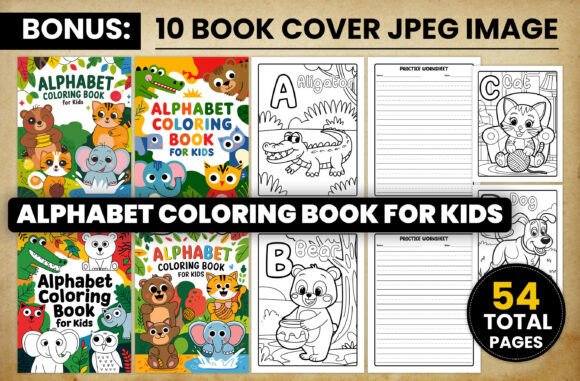
The 54 Pages Alphabet Coloring Book for Kids is more than a collection of printable pages—it’s a purpose-built, production-ready interior resource designed to accelerate execution for creators entering or expanding within the KDP coloring book niche. Its structure reflects intentional design thinking: 26 alphabet coloring pages with clean borders, 26 companion tracing worksheets, plus supporting pages—including a “Belongs To” label and color-testing sheet—adds functional depth beyond aesthetics. Delivered in multiple formats (EPS, PDF, PNG), it enables flexibility across workflows: print prep, digital adaptation, branding integration, or rapid iteration.
Why This Matters Strategically—Not Just Creatively
For entrepreneurs and educators, time-to-market and operational clarity are decisive advantages. The 54 Pages Alphabet Coloring Book for Kids eliminates foundational bottlenecks: no need to commission illustrations, license fonts, align letterforms with developmental appropriateness, or test line weight for coloring fidelity. Every page is sized at 8.5 x 11 inches—the KDP standard—and rendered at 300 DPI, meaning it meets platform requirements out of the box. That consistency reduces pre-launch friction, minimizes revision cycles, and supports predictable scaling—especially valuable if you’re building a series, testing market response, or managing multiple listings.
This isn’t about shortcutting quality; it’s about redirecting effort. Instead of troubleshooting vector alignment or tracing line thickness, you can focus on positioning, audience targeting, cover differentiation, or bundling strategy. For example, pairing this interior with your own custom-designed cover—or one of the included 10 high-resolution bonus book cover images—creates immediate visual distinction in a crowded category. That distinction compounds when applied across multiple titles: consistent interior logic (same spacing, same baseline style) builds subtle brand recognition among repeat buyers.
How to Use It Intentionally—Not Automatically
Using the 54 Pages Alphabet Coloring Book for Kids without context risks misalignment. A coloring book isn’t just content—it’s an experience shaped by sequence, pacing, cognitive load, and developmental intent. Consider these strategic filters before publishing:
- Audience fit: Are your buyers parents seeking early literacy support? Homeschoolers needing multisensory tools? Therapists looking for fine-motor practice? The tracing worksheets aren’t filler—they’re scaffolding. If your marketing emphasizes handwriting readiness, highlight those pages explicitly—not just as “bonus content,” but as pedagogically grounded components.
- Positioning clarity: Does your listing communicate *why* this interior stands apart? Generic descriptions (“fun alphabet pages!”) underutilize its structural advantages. Instead, anchor claims in observable features: “Each letter includes a bold, closed-outline border—optimized for crayon control and reduced bleed-through” or “Tracing lines follow D’Nealian-style stroke order, supporting classroom-aligned handwriting development.”
- Operational readiness: The EPS file allows precise edits—resizing, recoloring, or integrating custom icons—but only if you have access to vector software and know how to preserve print integrity. If not, lean into the PDF and PNGs. Don’t assume format versatility equals automatic usability.
Real-World Applications Beyond KDP Publishing
While built for KDP interiors, the 54 Pages Alphabet Coloring Book for Kids serves broader goals when approached deliberately:
- Educators: Print individual pages as targeted intervention tools—e.g., isolate letters with similar formation (b/d/p/q) for comparative tracing practice. The color-testing page becomes a low-stakes way to assess color recognition or fine-motor precision before full-page engagement.
- Freelancers & Designers: Use the EPS as a base layer when developing custom workbooks. Swap in client-branded elements while retaining proven layout logic—saving hours on grid setup and typography hierarchy.
- Homeschool Co-ops & Small Learning Centers: Bundle subsets (e.g., A–M + tracing) with simple instructions into weekly skill packets. The consistent sizing means seamless integration into existing binders or digital learning platforms via scanned PDFs.
- Content Creators: Repurpose PNGs into social media assets—time-lapse coloring videos, printable flashcards, or interactive Instagram stories asking followers to guess the letter from partial outlines. The clean borders and high contrast make these assets instantly legible at small scale.
Risks of Undifferentiated Use
Without clear goals, even well-structured resources like the 54 Pages Alphabet Coloring Book for Kids can dilute impact. Common pitfalls include:
- Blind bundling: Adding all 54 pages to every product without assessing relevance. A toddler-focused book may omit tracing pages entirely; an ESL resource might prioritize phonics cues over pure letter form.
- Ignoring metadata alignment: Uploading the interior without optimizing backend KDP keywords that reflect its dual function (coloring + handwriting practice). Search visibility suffers when backend terms don’t mirror actual usage patterns.
- Overlooking accessibility: While the line art is clear, consider adding alt-text descriptions for screen readers if distributing digitally—or noting contrast ratios in your description for users with visual sensitivities.
Planning Tips for Long-Term Value
Treat this asset as infrastructure—not just inventory. Here’s how to extend its utility:
- Map usage to business milestones: Launch your first title using the full interior. Then, use the EPS to create a simplified 20-page version for a lower-price entry point—or extract only uppercase letters for a “Capital Letters Only” spin-off.
- Track performance by component: Run A/B tests on listings where one highlights the tracing pages, another emphasizes the color-testing page. See which framing drives higher conversion or better reviews—and refine future messaging accordingly.
- Build documentation: Note which pages get the most engagement in reviews (“My child loved the ‘B’ page with the bear!”). That qualitative data informs sequels, themed expansions (animals, nature), or even licensing opportunities.
- Preserve version control: Save edited EPS files with clear naming (e.g., “ABC_Interior_v2_CursiveAddition.eps”). Avoid overwriting originals—future updates or audits depend on traceable iterations.
Final Strategic Observation
The 54 Pages Alphabet Coloring Book for Kids succeeds not because it’s exhaustive, but because it’s focused. Its value lies in constraint: 26 letters, 26 tracings, standardized dimensions, production-grade resolution. That constraint creates decision space elsewhere—in voice, audience insight, packaging, or service extension. It invites intentionality rather than default action. Whether you’re launching your first KDP title or refining a catalog of 50+ books, ask not “What can I add?” but “What does this interior allow me to do *better*, *faster*, or *more consistently*?” That question shifts emphasis from output to outcome—and from activity to advantage.
When used with clarity of purpose, the 54 Pages Alphabet Coloring Book for Kids becomes less of a template and more of a lever—one that multiplies effort, sharpens positioning, and supports sustainable growth across creative, educational, and entrepreneurial paths.