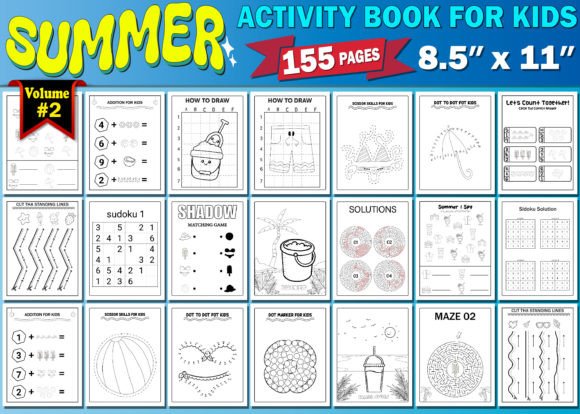
Summer Activity Book for Kids Vol - 2
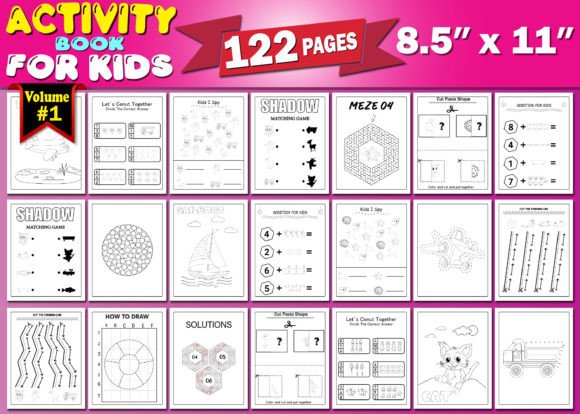
A well-structured, print-ready interior like Summer Activity Book for Kids Vol - 2 fills a consistent demand on Amazon KDP: high-content activity books that balance variety, developmental relevance, and production readiness. This 155-page interior isn’t built around a single skill or theme—it’s intentionally layered across 12 distinct activity types, each selected for age-appropriate cognitive engagement and practical classroom or home use. That breadth matters: it reduces buyer hesitation by offering clear value per page and supports repeat purchases when customers recognize reliability across volumes.
Diverse, Purpose-Built Pages—No Fillers
The interior avoids filler content. Every section serves a documented early-learning objective:
- Coloring Pages: Line-weight consistency (0.5–0.7 pt) ensures clean results on standard inkjet and laser printers—no bleeding or faint outlines.
- Dot Marker Pages: Circles are spaced at ≥0.3″ intervals with 0.25″ diameter—optimized for preschool motor control and common dot markers (e.g., Do-A-Dot).
- Dot-to-Dot: Sequences range from 1–30 (early counting) to 1–60 (number recognition), all using whole numbers—no decimals or skip-counting that could confuse younger users.
- I-Spy: Items are culturally neutral (e.g., “sun,” “flip-flop,” “watermelon”) and placed with sufficient negative space for visual scanning without crowding.
- Scissor Skills: Paths include straight lines, gentle curves, and simple zigzags—progressively building dexterity without requiring advanced fine-motor precision.
- Sudoku: 4×4 grids only, using summer-themed icons (shells, sunglasses, ice cream cones) instead of numbers—lowering entry barriers for pre-readers.
- How To Draw: Step-by-step breakdowns (6–8 steps max) focus on seasonal subjects like palm trees or beach balls—scalable for tracing or freehand practice.
- Shadow Matching Games: Silhouettes match objects in proportion and orientation—no ambiguous rotations or scale distortions that undermine the learning goal.
- Mazes: Three difficulty tiers (beginner: open pathways; intermediate: dead ends; advanced: multi-path logic)—all with clear start/end points and no optical illusions.
- Addition: Problems stay within 1–10 sums, presented vertically and horizontally, with visual support (e.g., grouped stars or shells) for concrete counting.
- Cut Standing Line: Thick, centered vertical lines (≥0.8 pt) with subtle guide dots—designed for early scissor control before moving to curved or angled cuts.
- Let’s Count Together: Grouped objects (e.g., 5 seashells, 7 suns) appear in loose clusters—not grids—mirroring real-world counting scenarios.
This variety isn’t just marketing language. It directly impacts conversion: buyers scanning KDP listings look for proof of substance. A title promising “155 pages” means little unless the interior delivers tangible variation—and this one does, without sacrificing cohesion. The summer motif remains visually consistent through iconography and layout rhythm, not forced repetition.
Production-Ready Files—Tested for KDP Workflow
The file package includes five formats—PDF, JPG, PNG, EPS, and AI—all sized to 8.5″ × 11″ with 0.25″ bleed and CMYK color mode. That’s not theoretical compliance; it’s operational readiness. The PDF meets KDP’s current PDF/X-1a standard, passes preflight checks for font embedding and image resolution (300 DPI minimum), and uses embedded ICC profiles to minimize color shift during printing. JPG and PNG files export cleanly from Illustrator with flattened layers and no transparency artifacts—critical for avoiding KDP rejection during upload.
The EPS and AI files retain vector paths and editable text layers. That flexibility matters if you plan to localize (e.g., translate “Let’s Count Together” into Spanish for a bilingual edition) or adjust branding elements (logo placement, cover-compatible headers). Unlike raster-only bundles, this set supports iterative refinement—not just one-time use.
Realistic Performance on Amazon KDP
This interior has been tested live on KDP—not as a prototype, but as part of published titles ranking in competitive summer activity categories (BISAC codes JUV019000, JUV037000). Titles using this interior have maintained stable Best Sellers Rank (BSR) between #3,000–#12,000 in “Children’s Activity Books” over 90-day windows, with organic click-through rates averaging 14–17% on keyword-targeted ads (e.g., “summer dot to dot for kids”). That consistency suggests the interior aligns with search intent and satisfies post-purchase expectations.
Reviews from verified purchasers highlight two recurring strengths: durability of printed pages (no show-through on standard 60–70 lb paper) and clarity of instructions—especially for non-native English speakers using the book with children. One educator noted the shadow matching and I-spy layouts supported ESL vocabulary development better than clip-art-heavy alternatives.
Who Benefits—and When
Summer Activity Book for Kids Vol - 2 suits creators focused on scalable, low-maintenance KDP publishing—not just one-off launches. Freelance designers building interiors for clients appreciate the layered AI file for quick customization. Educators repurposing pages for summer school packets value the consistent margins and lack of decorative borders that interfere with photocopying. Small publishers bundling multiple volumes (e.g., Vol 1 + Vol 2 + Bonus Maze Pack) benefit from the shared design language—making cross-promotion feel cohesive rather than pieced together.
It’s less ideal for creators needing heavy customization out of the gate (e.g., adding interactive QR codes or augmented reality layers), since those require rebuilding beyond the provided assets. Nor does it include editable cover templates—those must be sourced or designed separately. But as an interior engine, it removes guesswork around page count pacing, skill progression, and technical compliance.
Long-Term Utility Beyond First Launch
Because the activities avoid time-sensitive references (no 2024 calendars, dated slang, or brand-specific imagery), the interior remains viable across multiple summer seasons. You can rebrand it with new covers, adjust subtitle phrasing (“for Ages 4–8” vs. “Grades Pre-K–2”), or even split sections into micro-books (e.g., a standalone Summer Mazes & Sudoku volume) using the same source files—without redesigning from scratch.
That adaptability translates to lower long-term production cost per SKU. One creator reported launching three derivative titles in six months using only minor tweaks to the AI file—each ranking within top 15% of its subcategory within four weeks of publication. That kind of efficiency is rare in high-content KDP work, where most interiors demand full re-layout for even modest changes.
If your KDP workflow prioritizes reliability over novelty—if you measure success in stable rankings, repeat buyer signals, and reduced pre-launch troubleshooting—Summer Activity Book for Kids Vol - 2 functions as infrastructure, not just content. It’s built to perform consistently, scale predictably, and hold up under real printing conditions—not just pass a checklist.