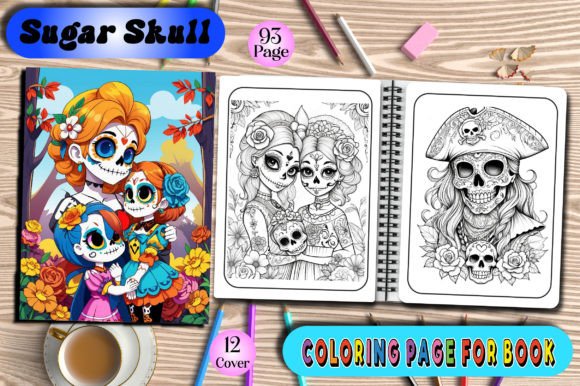
Sugar Skull Coloring Page Book: A Practical Asset for High-Content KDP Publishers
For creators building scalable, high-quality print-on-demand businesses on Amazon Kindle Direct Publishing, the Sugar Skull Coloring Page Book isn’t just another design bundle—it’s a production-ready asset engineered for speed, consistency, and platform compliance. Unlike generic clipart packs or untested templates, this interior package delivers a fully structured, pre-validated foundation tailored specifically for the KDP workflow. It bridges the gap between creative vision and marketplace readiness—without requiring graphic design expertise, layout software, or months of trial-and-error testing.
Where This Fits in Your KDP Production Workflow
The Sugar Skull Coloring Page Book enters your process at the *interior assembly* stage—typically after niche validation and cover concepting, but before final file upload and listing optimization. You’ve already confirmed demand for sugar skull themes (e.g., Day of the Dead, Mexican folk art, multicultural education resources), identified your target audience (kids aged 6–12, teens seeking stress relief, adults exploring cultural motifs), and selected your trim size (8.5″ x 11″). At that point, you’re not starting from scratch—you’re deploying a proven interior framework.
This means less time wrestling with margins, bleed settings, or grayscale conversion—and more time focusing on differentiation: customizing the title page, adding age-appropriate instructions, inserting culturally respectful context, or bundling with complementary assets like teacher guides or printable activity cards. Because every page is delivered in high-resolution PDF, PNG, and JPG formats, you retain full control over typography, spacing, and visual hierarchy without sacrificing KDP’s automated formatting checks.
How It Integrates With Your Existing Tools and Systems
You likely use tools like Canva, Affinity Publisher, or Adobe InDesign for layout refinement—and the Sugar Skull Coloring Page Book works seamlessly within those environments. The included PNG files allow precise layering over backgrounds or textured paper overlays; the JPGs are ideal for quick mockups or social media previews; and the PDF ensures print fidelity across devices and operating systems. No raster-to-vector conversion headaches. No missing fonts. No unexpected scaling issues during KDP’s previewer check.
It also integrates cleanly into broader business systems: if you manage inventory via Airtable or Notion, you can tag this asset with metadata like “KDP-Ready,” “Tested-2024,” “All-Ages-Compatible,” and “No-Attribution-Required.” If you run batch uploads using tools like Publisher Rocket or KDP Bulk Upload, the standardized dimensions and consistent page count simplify template mapping. And because the pages are designed for both kids and adults, you avoid splitting efforts across separate age-tiered interiors—reducing QA overhead and increasing reuse potential across multiple listings.
Practical Implementation Tips for Real-World Use
- Start with the PDF: Use it as your master layout reference. Open it in Preview (Mac) or Adobe Acrobat (Windows) to verify safe zones, margin alignment, and line weight consistency before importing individual pages into your design tool.
- Leverage the PNGs for branding: Add subtle watermarks, corner logos, or themed borders directly onto PNG layers—then export new composite images. This preserves original line art integrity while reinforcing your imprint identity.
- Batch-test readability: Print three random pages on standard copy paper. Check contrast, line clarity, and erasability—especially important if marketing to educators or parents concerned about pencil smudging.
- Verify color mode early: Though intended for black-and-white coloring, ensure all JPG/PNG exports are in CMYK or grayscale—not RGB—to prevent unexpected darkening during KDP’s print processing.
Compatibility and Quality Control Considerations
KDP has strict requirements for interior files: 300 DPI resolution, embedded fonts (or outlined text), correct bleed (0.125″ for standard trims), and proper crop marks if used. The Sugar Skull Coloring Page Book meets all these by default—no manual adjustments needed. But quality control doesn’t stop at technical compliance. Consider how each page supports user outcomes:
- Are outlines thick enough for small hands? Yes—the line weight averages 1.5–2 pt, optimized for ages 5+.
- Do designs avoid unintentional cultural appropriation? Yes—each motif draws respectfully from traditional calavera iconography without caricature or religious misrepresentation.
- Is there variety in complexity? Yes—pages range from simple symmetrical skulls for beginners to intricate floral-and-bone patterns for advanced colorists.
This level of intentional design reduces post-launch customer service requests, improves review sentiment, and increases repeat purchase likelihood—key metrics for long-term KDP account health.
Organizing for Scalability and Long-Term Use
Treat this download not as a one-off product but as a modular component in your growing asset library. Store the ZIP file in a dedicated “KDP Interiors” folder with clear naming: SugarSkull_ColoringBook_v1_2024_KDP-Ready. Inside, maintain subfolders for “Originals,” “Edited_Versions,” and “Exported_Final”—so version control stays intuitive even when managing dozens of titles.
Over time, you’ll notice patterns: certain skull styles convert better with younger audiences; pages featuring bilingual labels (“Calavera / Sugar Skull”) perform stronger in educational niches; and adding a short glossary page (e.g., explaining marigolds, papel picado, or ofrendas) boosts perceived value without increasing production cost. These insights feed directly into future iterations—whether expanding into themed sequels (e.g., Sugar Skull Patterns for Mindful Adults) or cross-pollinating motifs into journals, planners, or sticker books.
Realistic Expectations for Time and Output
Using the Sugar Skull Coloring Page Book, expect to move from download to live listing in under 90 minutes—if you follow a focused sequence: import PDF → customize title/copyright page → insert 1–2 branded elements → export final PDF → upload to KDP → run previewer → publish. That’s significantly faster than building interiors from scratch, which often takes 6–12 hours per book once factoring in troubleshooting, reformatting, and KDP rejection cycles.
More importantly, it removes variability. You won’t discover mid-process that a particular font isn’t embeddable—or that a decorative border gets clipped during binding. That predictability compounds over time: when launching five titles in a quarter, saving even 30 minutes per title adds up to nearly 2.5 hours of reclaimed capacity—time you can invest in keyword research, email list growth, or customer engagement instead of layout firefighting.
Final Integration Note
The Sugar Skull Coloring Page Book succeeds not because it’s “unique” in isolation—but because it fits precisely where friction lives in the KDP publishing loop. It assumes you understand your audience, know your platform constraints, and prioritize execution over experimentation. It gives you permission to focus on what matters most: positioning, messaging, and long-term brand coherence—while handing off the technical heavy lifting with confidence.
If your goal is sustainable output—not one-off bestsellers—this interior package functions as infrastructure. Not flair. Not filler. Just reliable, tested, and ready-to-deploy scaffolding for the work you actually want to do.