Windmill Coloring Book: A Practical, High-Content Resource for KDP Creators and Creative Entrepreneurs
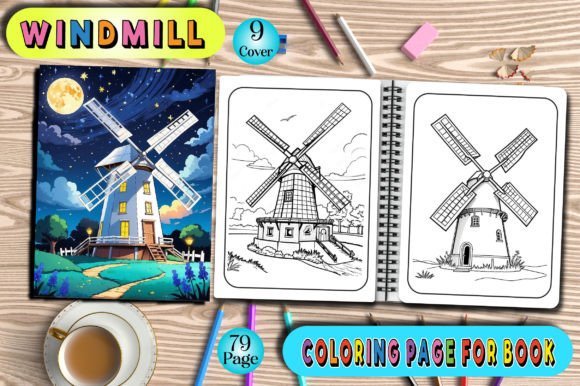
If you’re building a high-content book business on Amazon Kindle Direct Publishing, you know how much time goes into sourcing clean, versatile, and platform-tested interior assets. The Windmill Coloring Book isn’t just another generic coloring page pack—it’s a purpose-built interior solution designed for real-world KDP workflows. It delivers ready-to-use, high-resolution windmill-themed coloring pages that work equally well for kids’ activity books, adult relaxation titles, classroom printables, or hybrid “all-ages” collections.
What You’re Actually Getting (and Why It Matters)
This isn’t a bundle of loosely themed clipart or low-DPI JPEGs scaled up until they pixelate. Every file in the Windmill Coloring Book download has been stress-tested on KDP: 8.5″ x 11″ PDF interiors render crisply at 300 DPI, PNGs retain transparent backgrounds for custom layouts, and JPGs load fast without compression artifacts. That means less troubleshooting during upload, fewer “low-resolution image” warnings, and more time spent on cover design, keyword research, or launching your next title.
The set includes multiple windmill variations—Dutch-style, modern farm silhouettes, whimsical cartoon versions, and even simplified outlines ideal for early elementary learners. Each page is intentionally spaced and centered, with no bleed or margin issues that force last-minute cropping in Canva or Adobe InDesign. And yes—the children’s pages are distinct in line weight and complexity from the adult-focused ones, so you’re not accidentally selling a toddler-level outline to buyers expecting intricate botanical-windmill hybrids.
Where This Fits Into Real KDP Workflows
Let’s talk about actual use cases—not hypotheticals.
- A homeschooling parent launching their first KDP book: They combine four windmill coloring pages from this pack with original nature facts and a short glossary, turning it into a “Farm Life Learning Workbook” for grades K–2. No illustration skills needed—just thoughtful assembly and clear educational framing.
- A freelance designer building a seasonal catalog: They drop three high-res windmill PNGs into a July-themed “Summer Relaxation Bundle” alongside beach scenes and lemonade illustrations. Because the files are layered and background-free, they can overlay subtle watercolor textures or add soft drop shadows—without needing Photoshop expertise.
- An educator creating supplemental materials: Instead of paying $49/month for a subscription-based worksheet site, they license this one-time download and integrate windmill pages into a unit on renewable energy. One page shows turbine mechanics with labeled parts; another invites students to sketch how wind moves through blades. It’s tactile, screen-free, and curriculum-adjacent.
- A small publisher scaling a “European Landmarks” series: They use the Dutch windmill pages as anchor content for Volume 3, then commission two custom illustrations (a canal scene + a tulip field) to round out the theme. The existing assets reduce upfront art costs by ~60% while keeping visual consistency across volumes.
Who Benefits—and How Their Goals Shift the Use Case
Your goals shape how you’ll apply the Windmill Coloring Book. A hobbyist printing personal copies for family road trips only needs the PDF. But if you’re listing on KDP, you’ll lean on the PNGs for flexible cover mockups and the JPGs for quick social media teasers. An educator might extract single pages for Google Classroom handouts, while a marketer repurposes them as lead magnets (“Download 3 Free Windmill Coloring Pages + Energy Facts PDF”).
Here’s what changes depending on your role:
- Freelancers appreciate the clean vector-style lines—they scale without distortion when adapting pages for planners, greeting cards, or sticker sheets.
- Bloggers embed a windmill coloring page in a “10 Calming Activities for ADHD Kids” post, then link to their KDP version in the conclusion—no need to build from scratch.
- Small business owners print select pages on cardstock, laminate them, and use them as quiet-time tools in waiting rooms or cafes—especially effective in rural or agritourism areas.
- Self-publishers use the included cover images as templates, swapping fonts and subtitles to test multiple niches: “Windmill Coloring for Toddlers,” “Vintage Windmills: Stress Relief for Adults,” or “Dutch Heritage Coloring Journal.”
What to Consider Before You Download or List
Even great assets require smart implementation. First—verify your niche alignment. Windmills resonate strongly in Netherlands-, agriculture-, sustainability-, or European travel-themed books—but feel out of place in urban mindfulness or jungle animal collections unless creatively reframed (e.g., “Renewable Energy Heroes” or “Wind Power Explorers”).
Second—check KDP’s latest interior guidelines. While this pack was tested under current specs, Amazon occasionally updates file requirements (like mandatory bleed settings or color mode restrictions). Always run a final pre-upload check using KDP’s previewer—not just your local PDF viewer.
Third—think beyond the page. These windmill designs are neutral enough to support diverse backmatter: add QR codes linking to wind energy videos, include blank journal prompts (“What does ‘power from nature’ mean to you?”), or pair with simple science experiments (build a pinwheel, track local wind patterns). The coloring pages become entry points—not endpoints.
Why This Works When Other Packs Don’t
Most coloring page bundles either overcomplicate (adding unnecessary effects, inconsistent sizing, or overlapping elements) or oversimplify (repeating the same windmill 20 times with minor tweaks). The Windmill Coloring Book avoids both traps. Each page stands alone visually, but collectively they form a cohesive aesthetic—clean, friendly, and scalable.
You’ll notice no copyright watermarks, no forced attribution lines, and no hidden upsells. What you see is what you get: usable, commercial-ready files with zero legal ambiguity for KDP. That clarity saves hours—whether you’re drafting your first book description or scaling to 50+ titles in your catalog.
And because it’s built for Amazon’s ecosystem—not generic stock platforms—you’re not competing with thousands of identical listings. You’re starting from a tested foundation, then layering in your voice, audience insight, and marketing strategy. That’s where real differentiation happens—not in the line art, but in how thoughtfully you connect it to people’s actual needs.